Quick Start
1D Model
import puffin_disk

# Example input values
m_star    = 0.3       # M_sun
r_d       = 100       # AU
sigma_1au = 1000      # g cm^-2
F_FUV     = 1e3       # G_0

# Run PUFFIN
model = puffin_disk.DiskModel1D(m_star, r_d, sigma_1au, F_FUV)
r_array, rho_array = model.compute()
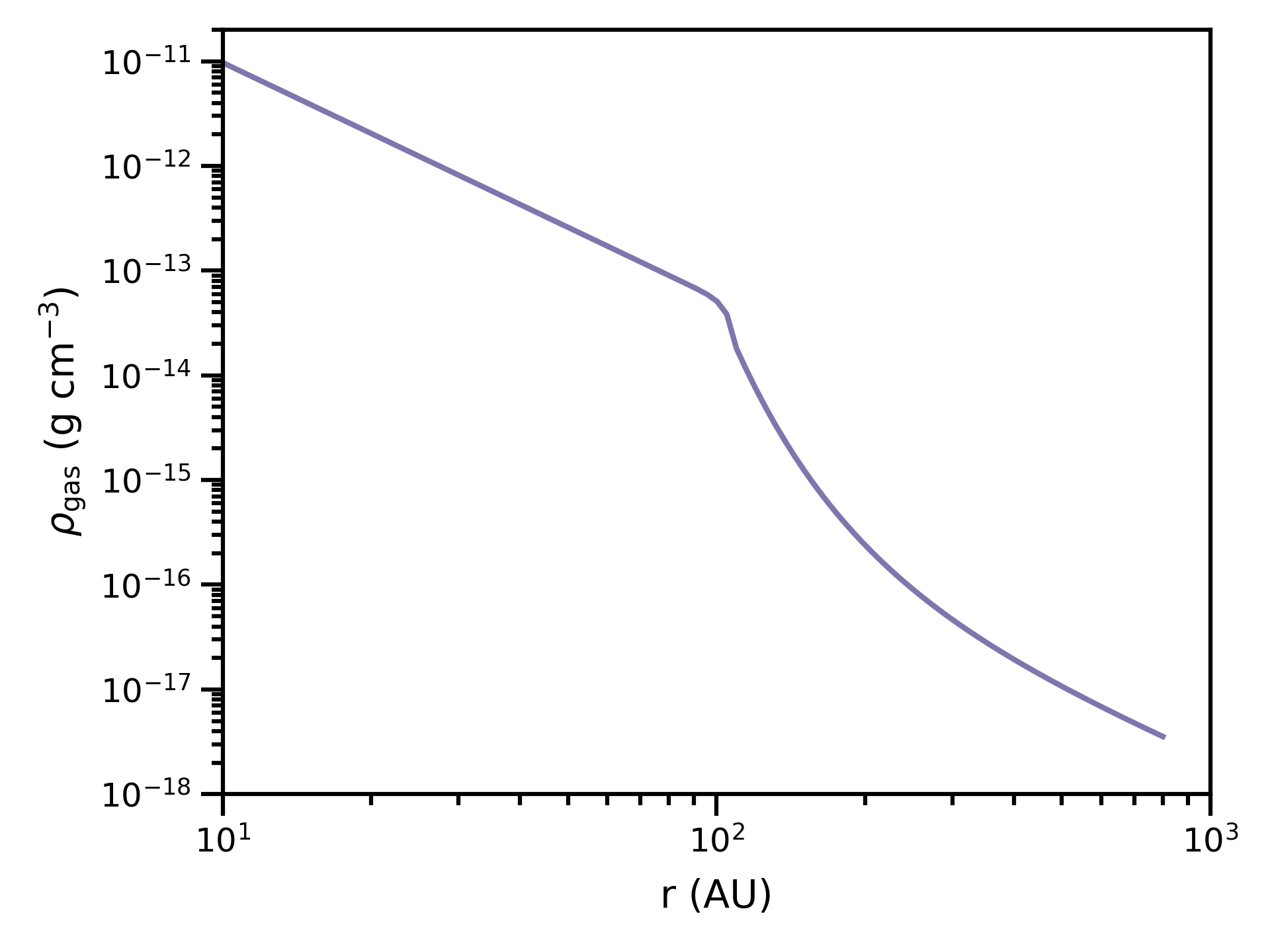
The model returns 1D arrays for radius and density. These can then be plotted:
import matplotlib.pyplot as plt

plt.loglog(r_array, rho_array)
plt.show()
2D Model
import puffin_disk

# Example input values
m_star    = 0.3       # M_sun
r_d       = 100       # AU
sigma_1au = 1000      # g cm^-2
F_FUV     = 1e3       # G_0

# Run PUFFIN
model = puffin_disk.DiskModel2D(m_star, r_d, sigma_1au, F_FUV, gamma=3.0)
r_array, z_array, rho_array = model.compute()
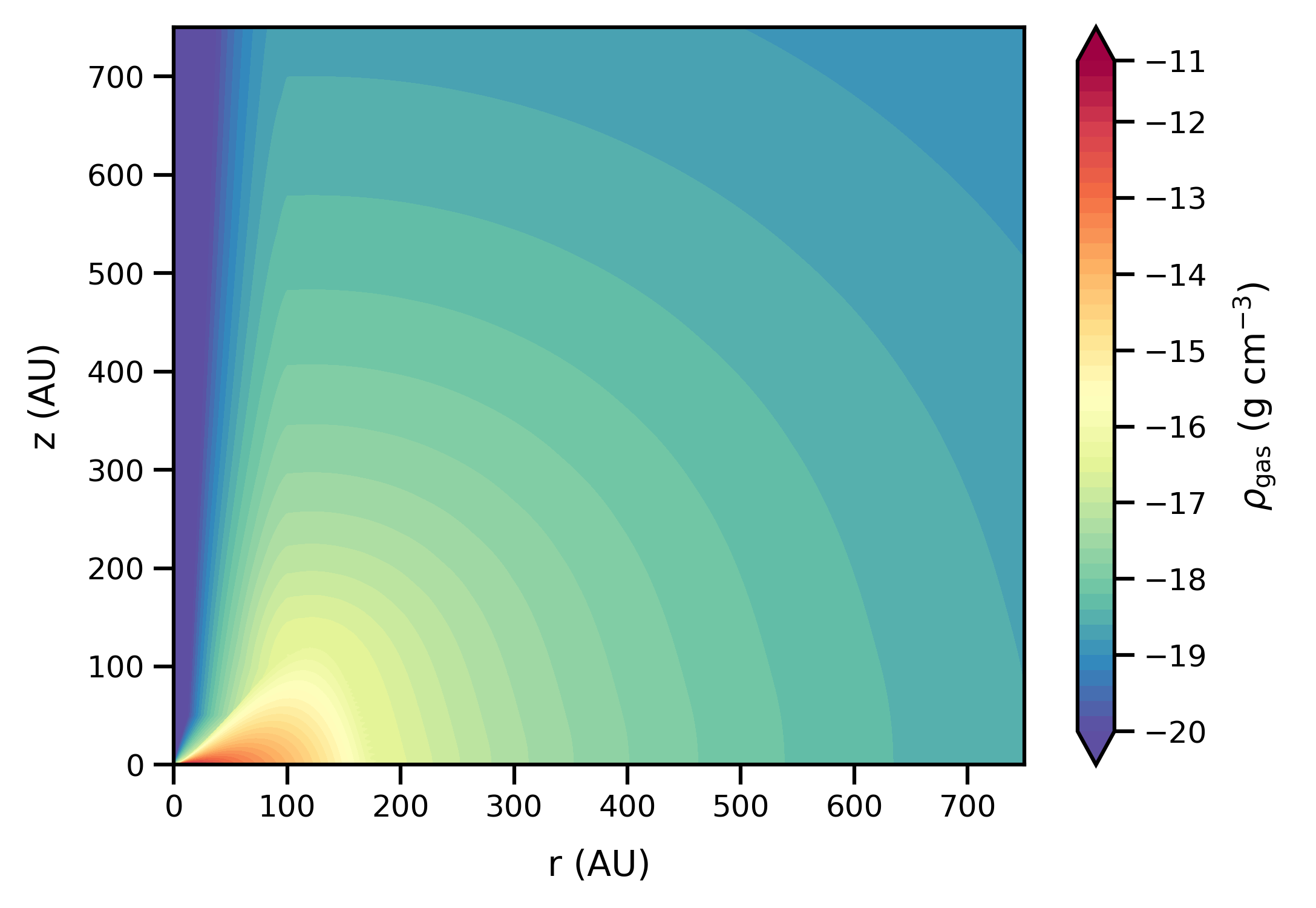
The model returns 1D arrays for radius and height, and a 2D density array. These can then be plotted:
import matplotlib.pyplot as plt

plt.contourf(r_array, z_array, np.log10(rho_array), cmap='Spectral_r', levels=np.arange(-20, -11, 0.2), extend='both')
plt.show()
Tweaking the Models
Both the 1D and 2D PUFFIN models include several optional parameters that allow you to customize the numerical grid and physical behavior. These parameters are passed directly to the DiskModel1D and DiskModel2D constructors and can be directly adjusted.
The available options are summarized below.
Parameter |
Type |
Description |
|---|---|---|
|
|
Number of grid points used in the radial (and vertical, for 2D) directions. Default is 1000. Higher resolution (≥1000) is recommended for accurate hydrostatic equilibrium solutions. |
|
|
Outer radius of the computational grid in AU. Default is |
|
|
Mass-loss rate in M☉ yr⁻¹. If |
|
|
Exponential cutoff parameter for the surface density profile. If |
|
|
Power-law index controlling the disk-wind transition associated with the disk radius ( |
|
|
Power-law index controlling the disk-wind transition associated with the external FUV field ( |
|
|
Parameter controlling steepness of vertical temperature gradient. Default is 1.75. |
|
|
Number of hydrostatic equilibrium iterations. Default is 20. Increasing this may improve convergence at the cost of runtime. |
|
|
Turn on/off messages to the console. Default is TRUE. |
In most cases, the default settings provide a good balance between accuracy and performance. Advanced users may wish to increase resolution or iteration count when exploring detailed vertical structure or testing convergence.